Hotel management far exceeds merely learning about hospitality, guest services or hotel administration. For aspiring hospitality professionals, the knowledge about what happens behind the scenes is equally important. The kitchen is one of the most dynamic areas of a hotel, where time management, teamwork, communication, food safety and culinary skills converge seamlessly.
This is why practical exposure to real-time kitchen operations is an essential part of professional hotel management training. At George Group of Colleges, students get opportunities to understand how a professional kitchen functions and how different teams coordinate to deliver quality food and service efficiently.
Learning the Workflow of a Professional Kitchen
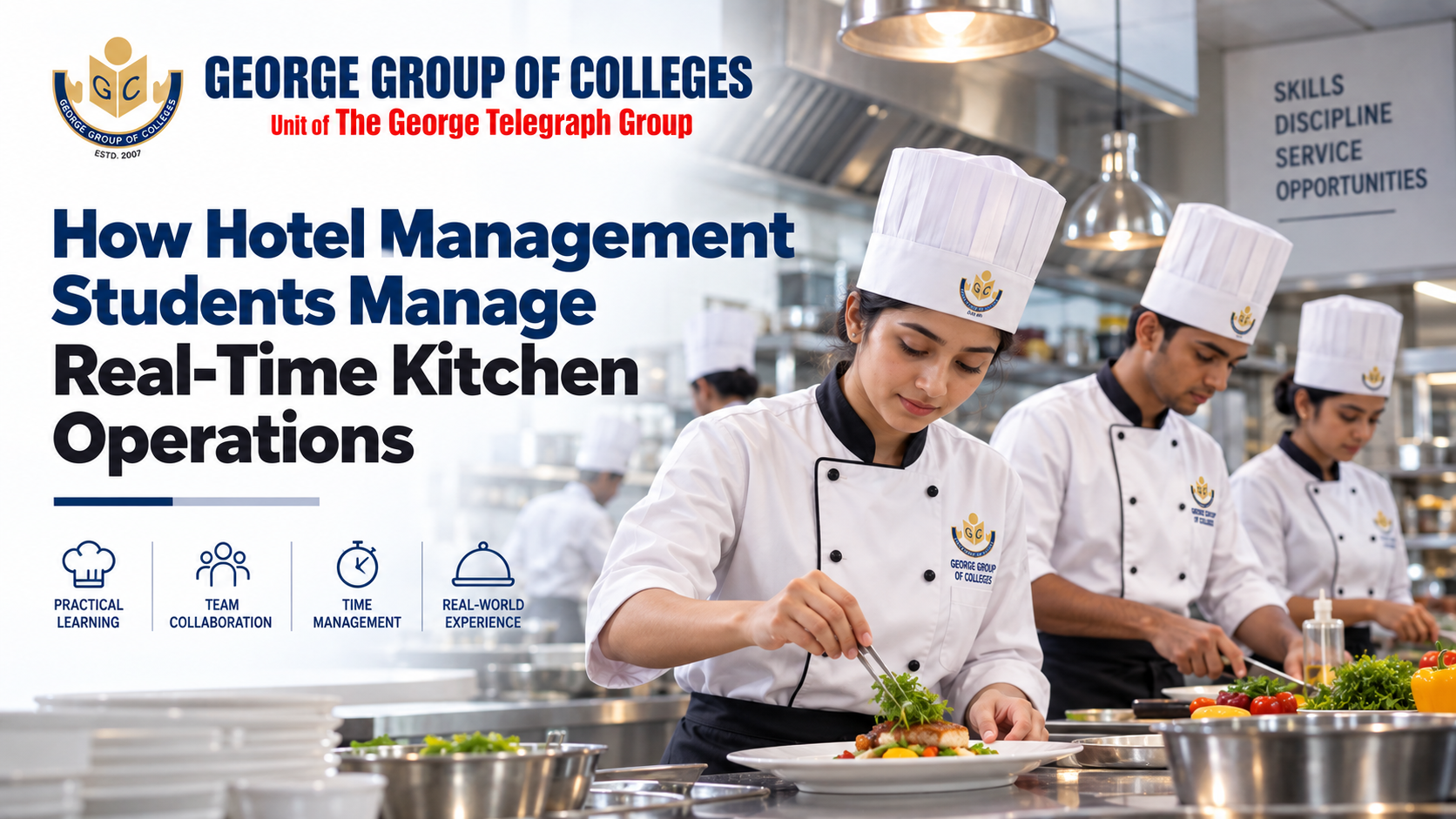
A commercial kitchen operates through a carefully organized workflow. Before cooking begins, students need to understand processes such as receiving ingredients, checking their quality, storing food appropriately, preparing ingredients and organizing workstations.
Hotel management students learn that every stage contributes to the final dining experience. Proper mise en place, for instance, ensures that ingredients, equipment and utensils are in place, before cooking starts. This helps reduce delays and allows kitchen teams to work efficiently during busy service periods.
Through practical training, students can understand how different sections of a professional kitchen function, including food preparation, cooking, bakery, garde manger and service coordination.
Managing Time during Busy Service
One of the biggest challenges in real-time kitchen operations is managing multiple orders simultaneously. During breakfast, lunch or dinner service, professional kitchens may have to prepare several dishes at the same time while maintaining consistency and presentation.
Students learn to prioritize tasks according to preparation time and service requirements. They also develop the ability to remain organized when the pace of work increases.
This practical experience helps hotel management students understand that successful kitchen operations depend not only on cooking ability but also on efficient planning and time management.
Teamwork and Kitchen Communication
A hotel kitchen functions as a team. Chefs, commis chefs, kitchen assistants, stewards and service staff need to communicate clearly to ensure smooth operations.
Students therefore learn the importance of professional communication and coordination. They become familiar with kitchen hierarchy, work allocation and the responsibilities associated with different roles.
At George Group of Colleges, practical learning helps students appreciate the importance of teamwork in hospitality. Working alongside peers in simulated or practical kitchen environments allows them to develop confidence while understanding how individual responsibilities contribute to overall performance.
Maintaining Food Safety and Hygiene
Food safety is a fundamental part of hotel kitchen management. A professional kitchen must maintain high standards of personal hygiene, equipment cleanliness, food storage and temperature control.
Hotel management students learn why raw and cooked food should be handled appropriately and why workstations need to be cleaned and sanitized regularly. They also learn about preventing cross-contamination and following standard food-handling practices.
Such knowledge is crucial because hospitality professionals are responsible not only for preparing attractive meals but also for ensuring that food is safe for guests.
Controlling Quality and Portioning
Consistency is another important aspect of kitchen operations. Guests expect the same quality, taste and presentation every time they order a particular dish.
Students learn the importance of standard recipes, accurate measurements, portion control and appropriate cooking techniques. These practices help kitchens control costs while maintaining food quality.
Learning portion control also introduces students to an important business aspect of hospitality, the relationship between food quality, inventory and profitability.
Handling Pressure and Unexpected Situations
Real-time kitchen operations rarely go exactly according to plan. Ingredients may run short, equipment may malfunction, orders may increase suddenly or a dish may need to be prepared again.
Practical hotel management training helps students develop problem-solving and decision-making abilities in such situations. They learn to stay calm, communicate with their team and find workable solutions without compromising food safety or service standards.
These experiences are particularly valuable for students preparing to enter fast-paced hospitality establishments.
Building Employability through Practical Learning
The hospitality industry values professionals who can apply theoretical knowledge in real working environments. Classroom learning provides the foundation, but practical experience helps students understand how those concepts are applied.
Through practical hotel management training, students can develop skills such as, kitchen organization, food preparation and production, time management, team coordination, food safety and hygiene, cost and portion control, communication, problem-solving and professional discipline.
These skills can make graduates better prepared for careers in hotels, restaurants, resorts, catering companies, cruise hospitality and other food-service businesses.
George Group Offers Best Kitchen Experience
The journey from a hospitality student to a confident professional involves exposure to real workplace expectations and an understanding of how different departments operate together.
At George Group of Colleges, the emphasis on practical learning helps students connect academic concepts with professional requirements, by experiencing the pace, discipline and teamwork involved in the demanding environment of real-time kitchen operations. For students considering a hotel management course in Kolkata, choosing an institution, like George Group, that combines classroom learning with practical exposure can be an important step towards building a successful hospitality career.
Hospitality professionals should learn not just how to prepare food, but how to manage an entire operation efficiently.