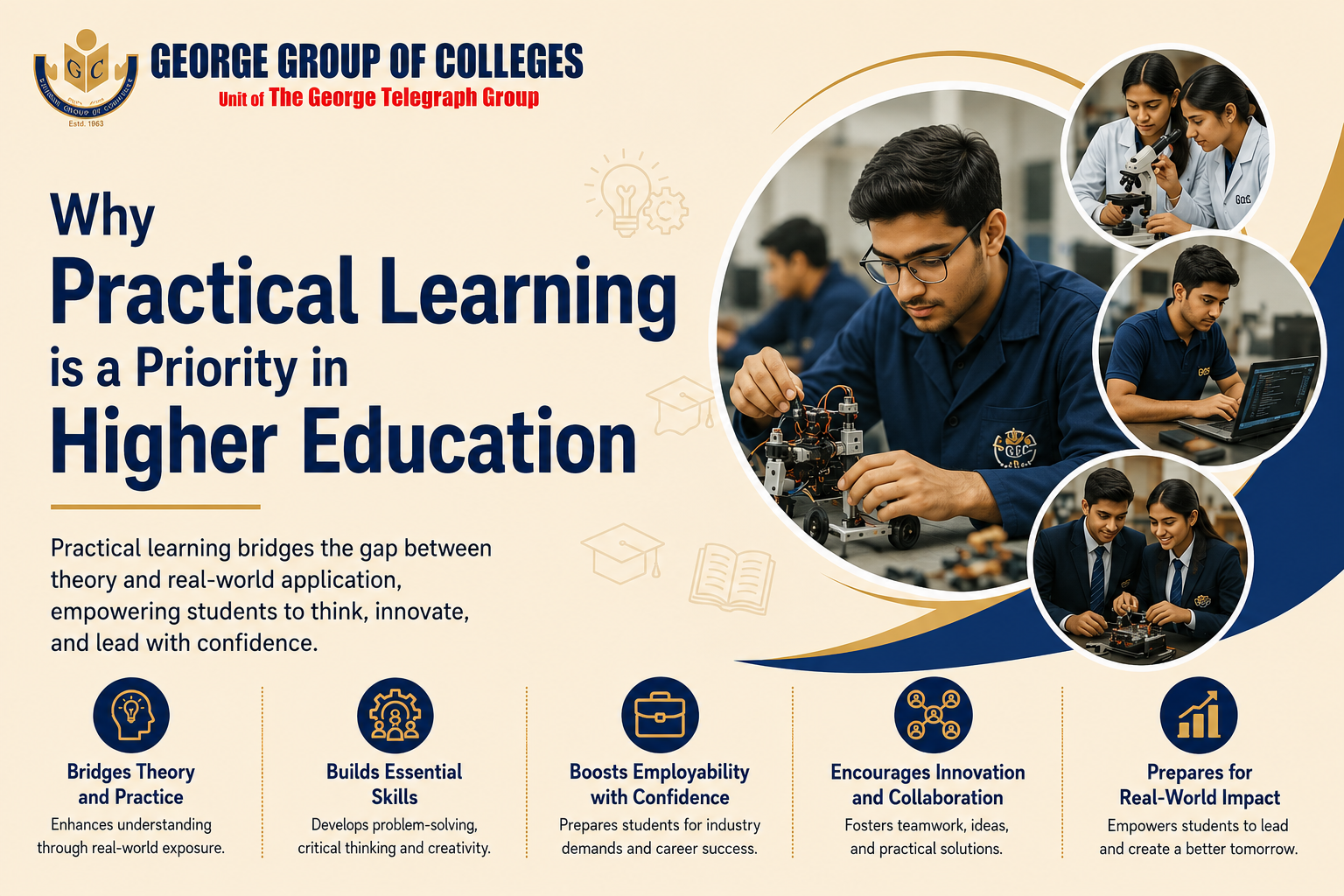
Nowadays, academic excellence alone is no longer enough to guarantee career success. Employers across industries are increasingly seeking graduates who possess not only theoretical knowledge but also practical skills, problem-solving abilities, adaptability and real-world experience. This shift has made practical learning an essential component of modern higher education.
Institutions that focus on skill-based education and hands-on learning are better equipped to prepare students for industry demands and future career opportunities. At George Group of Colleges, the emphasis on industry-oriented education helps students bridge the gap between classroom theories and workplace realities.
Understanding Practical Learning in Higher Education
Practical learning refers to educational approaches that encourage students to apply theoretical concepts through real-world experiences, projects, internships, laboratory work, workshops, simulations, field visits and collaborative assignments. Unlike conventional rote learning methods, experiential learning allows students to engage actively with their subjects.
Modern employers value candidates who can demonstrate practical expertise alongside academic credentials. This is why career-focused education and industry-oriented education have become central to progressive academic institutions worldwide.
Students today need exposure to real-life challenges, workplace communication, digital tools, and professional environments. Learning by doing not only improves understanding but also enhances retention, creativity and analytical thinking.
Why Practical Learning Matters More Than Ever
Enhances Employability Skills. One of the greatest advantages of hands-on learning is that it significantly improves employability. Many graduates struggle during job interviews because they lack practical exposure despite having strong academic records.
Employers prefer candidates who already possess workplace-ready skills such as, team collaboration, communication, critical thinking, leadership, technical proficiency and problem-solving abilities
Through internships, workshops, and industry projects, practical education enables students to become job-ready before graduation.
This is particularly important in competitive sectors like management, healthcare, media science, hospitality, information technology, and sports management, where practical expertise plays a crucial role in professional growth.
Bridges the Gap between Theory and Industry.
Traditional classroom education often focuses heavily on theoretical concepts. While theory forms the foundation of knowledge, students also need opportunities to understand how those concepts function in real-world situations.
For example, a business management student may study marketing strategies in textbooks, but practical exposure through live campaigns, presentations, and case studies develops actual professional competence.
Similarly, students pursuing healthcare or technical programs benefit immensely from laboratory training, simulations, and industry interactions.
This combination of theory and application creates a stronger learning ecosystem and promotes industry-integrated education.
Builds Confidence and Decision-Making Abilities. Students involved in project-based learning and practical assignments become more confident in handling responsibilities and making decisions independently.
Participating in presentations, group discussions, internships, and workshops allows students to overcome fear, improve communication skills, and develop leadership qualities.
Confidence is a critical factor in career success, and experiential learning programmes help students gain that confidence through continuous exposure to real-world situations.
Practical learning also teaches students how to handle challenges, manage deadlines and adapt to changing circumstances, qualities highly valued in professional environments.
Encourages Innovation and Creativity.
Modern industries demand innovation. Organizations seek professionals who can think creatively and provide practical solutions to emerging challenges.
Skill-oriented higher education encourages students to experiment, analyse and innovate rather than simply memorize information. Activities such as research projects, industry case studies, startup incubation programmes and collaborative assignments help students develop creative thinking abilities.
This culture of innovation is especially beneficial in fields such as digital marketing, media science, healthcare management and technology-driven disciplines.
Prepares Students for the Future Workplace. The future workplace will increasingly depend on digital literacy, adaptability, communication and interdisciplinary knowledge. Employers now prioritize practical competencies over purely theoretical expertise.
Institutions that provide career-focused education prepare students to thrive in dynamic work environments by exposing them to industry practices, technological advancements and professional ethics.
Through internships, seminars, industrial visits and workshops, students gain valuable insights into workplace expectations and organizational culture.
This exposure makes the transition from college to career smoother and more effective.
Growing Importance of Internships and Industry Exposure
Internships are among the most powerful forms of practical training programmes for students in India. They allow learners to gain firsthand experience in professional settings while still pursuing their academic courses.
Benefits of internships include, real-world work experience, professional networking opportunities, improved resume strength, better understanding of career goals and increased confidence and communication skills
Similarly, industry collaborations and corporate interactions help students understand emerging trends and evolving market requirements.
This is why many students today actively search for colleges offering industry exposure in Kolkata and best universities for experiential learning in India.
How George Group of Colleges Promotes Practical Learning
George Group of Colleges believes that education should empower students with both academic knowledge and professional readiness.
The institution promotes hands-on learning through, industry-oriented curriculum, workshops and seminars, laboratory-based training, internship opportunities, field projects, personality development programmes, interactive classroom sessions and industry interaction and exposure.
By combining classroom education with practical experiences, the college helps students become future-ready professionals capable of succeeding in competitive industries.
Students looking for career-focused colleges in Kolkata increasingly prefer institutions that emphasize practical exposure and professional skill development.
The Future of Higher Education Lies in Practical Learning
The global education ecosystem is gradually shifting toward outcome-based education and competency-driven learning models. Universities and colleges are redesigning academic frameworks to ensure students graduate with industry-relevant skills.
As automation and artificial intelligence continue to reshape industries, students must develop practical competencies that machines cannot easily replace, such as creativity, emotional intelligence, leadership and critical thinking.
Therefore, practical learning in higher education is no longer optional, it is essential.
Educational institutions that prioritize real-world learning experiences for university students will play a major role in shaping capable, innovative and employable graduates for the future.
George Group recognizes importance of Practical Learning
In an increasingly competitive and technology-driven world, the value of practical learning cannot be overstated. It enhances employability, strengthens confidence, promotes innovation, and prepares students for real-world challenges.
Modern students require more than textbook knowledge, they need exposure, experience, and industry-relevant skills to build successful careers.
By integrating experiential learning, internships, industry interaction, and skill-based education into academic programes, institutions can create a meaningful and future-ready educational environment.
George Group of Colleges continues to recognize the importance of practical education in shaping competent professionals and empowering students for long-term success in the evolving global workforce.