Walk into any large private hospital in India today and you’ll notice something beyond the doctors and nurses, a quiet, behind-the-scenes workforce keeping the entire operation running. Bed allocation, billing, insurance claims, compliance, patient flow, vendor contracts. None of that happens by accident. It happens because someone is managing it and India is running short of those someone’s, fast.
The country’s healthcare sector has been expanding at a pace few other industries can match. New hospital chains are opening in tier-2 and tier-3 cities. Insurance penetration is climbing. Medical tourism is back to pre-pandemic levels and growing. Every one of these trends needs trained hospital managers. India 2030 projections suggest the country simply does not have enough of yet.
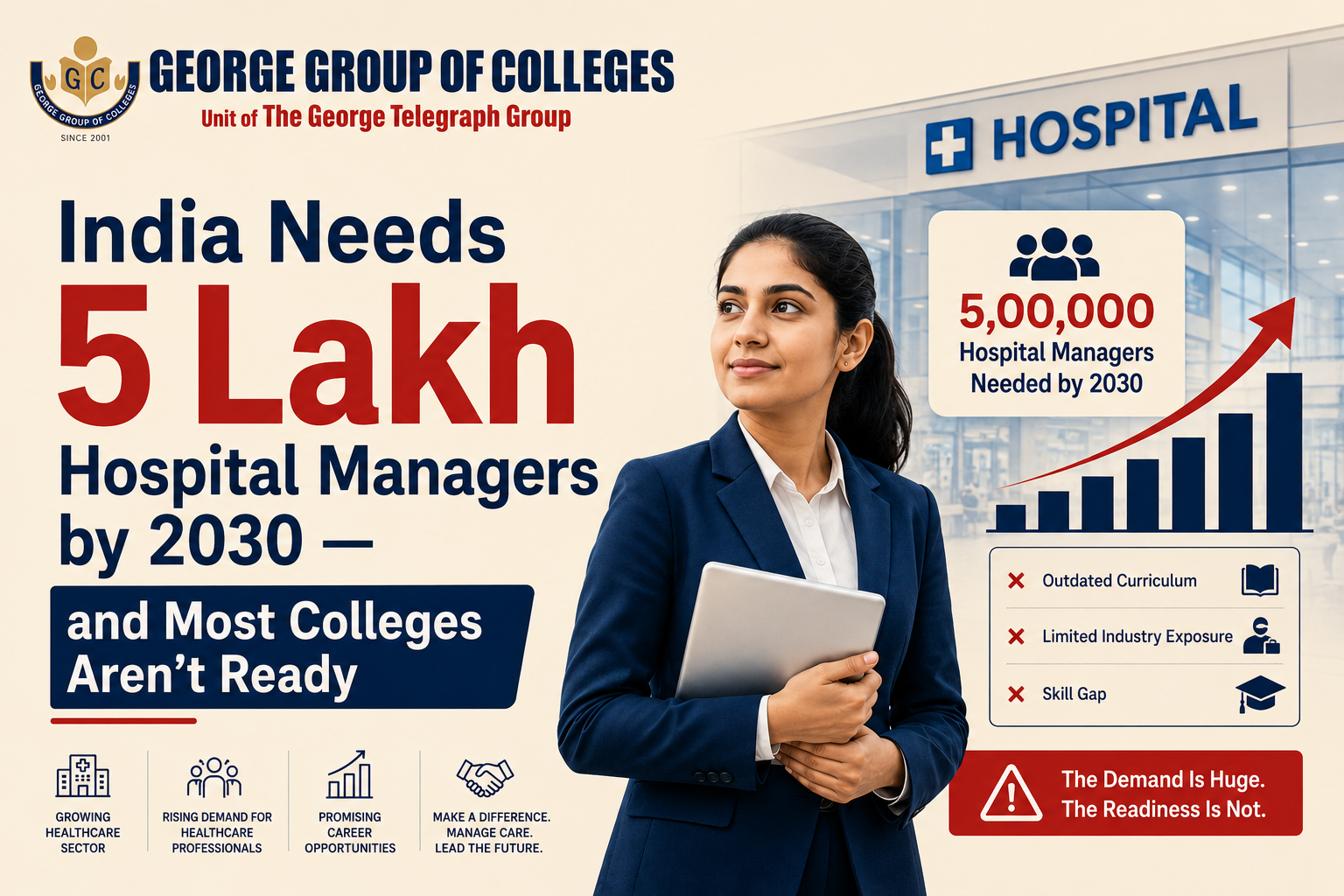
Industry estimates point to a requirement of nearly 5 lakh trained hospital managers by 2030, and most colleges offering healthcare management programs haven’t updated their curriculum to match what hospitals actually need today.
Why India Will Need More Hospital Managers by 2030
The maths is fairly straightforward once you look at what’s happening on the ground. Hospital chains are adding thousands of beds every year. Each new facility needs administrators, operations heads, billing managers, and quality officers—not just doctors.
Private healthcare has grown into one of the largest employment generators in the services sector, and that growth shows no signs of slowing. More hospitals mean more layers of management, from front-office operations to procurement and facility planning.
Digital healthcare transformation adds another layer of demand. Hospitals are adopting electronic health records, telemedicine platforms and AI-based diagnostic tools—all of which need people who understand both healthcare and technology to manage the rollout.
NABH accreditation has also become a major driver. Hospitals seeking accreditation need managers trained in quality systems, documentation and patient safety protocols, and that’s a specialised skill set most general MBA graduates don’t have.
Medical tourism is another factor that often gets overlooked. International patients expect smooth coordination—visas, travel, treatment packages, follow-up careand that requires dedicated medical tourism coordinators, a role that barely existed a decade ago.
Add to this the rapid growth of health insurance coverage across the country, and the operational complexity of running a modern hospital has multiplied. Someone has to manage claims processing, TPA coordination, policy complianceand right now, there aren’t enough people trained to do it well.
What’s Causing the Shortage of Hospital Administrators in India?
The shortage of hospital administrators India faces isn’t because students aren’t interested. It is because the supply pipeline hasn’t kept up with demand and the training on offer often doesn’t match what hospitals actually need.
Specialised institutions offering dedicated hospital management programs remain limited in number. Many colleges still treat healthcare management as a minor specialisation within a general business degree, rather than a standalone discipline with its own depth.
Curricula in several programmes haven’t been revised in years. Students graduate having studied hospital administration theory from textbooks written before electronic health records became standard, with little exposure to how a modern hospital actually operates.
Practical exposure is another gap. Classroom case studies can only go so far. Without structured internships inside real hospitals, graduates often start their first job without ever having seen a billing system, a bed management dashboard, or a quality audit in action.
There is also a persistent industry-academia gap. Hospitals want graduates who can step in and contribute from day one, while many programmes are still producing generalists. The result is a mismatch where jobs go unfilled even as graduates struggle to find roles.
Put all of this together, and demand is simply outpacing supply, both in raw numbers and in the quality of training being delivered.
Are Colleges Preparing Students for Modern Healthcare Management?
Some colleges are getting this right and it would be unfair to paint the entire sector with the same brush. A growing number of institutions have started introducing internships as a mandatory component, placing students inside hospitals for several months before graduation.
Hospital information systems are increasingly part of the syllabus, with students learning how patient records, billing and inventory management software actually work in practice rather than just in theory.
AI in healthcare is also slowly making its way into coursework, particularly around predictive analytics for patient admissions, staff scheduling and resource allocation. Healthcare analytics modules are becoming more common too, teaching students to read operational data and make decisions based on it.
Leadership skills, financial management, and patient experience training remain uneven across institutions. Some programs run dedicated modules on hospital finance and patient satisfaction frameworks, while others still treat these as one-off lectures rather than core competencies.
The honest picture is mixed. Top-tier institutes are adapting reasonably well, while many smaller colleges are lagging behind and that gap is exactly what’s widening the skills shortage.
Current Workforce vs Future Demand (Comparison Table)
| Aspect | Current Situation | 2030 Healthcare Workforce Needs |
| Trained Professionals | Limited pool, concentrated in metro cities | Estimated 5 lakh hospital managers required nationwide |
| Industry Demand | Moderate, growing steadily | Sharp rise driven by hospital expansion and private healthcare growth |
| Technology Readiness | Many institutes still teaching traditional administration | Hospital information systems, AI, and analytics as core skills |
| Practical Exposure | Limited internships, mostly classroom-based | Live hospital training and industry partnerships expected as standard |
| Skill Requirements | Basic administration, finance, HR | Digital health tools, data analysis, quality accreditation, leadership |
| Career Opportunities | Hospital administrator, operations roles | Expanded roles in medical tourism, insurance, data, patient experience |
| Salary Growth | Steady but slow for entry-level roles | Faster growth for digitally skilled, NABH-trained professionals |
| Hiring Outlook | Selective hiring, fewer specialised roles | Large-scale hiring across hospitals, insurers, and health-tech firms |
What Should Students Look for in a Hospital Management Programme?
If you’re evaluating training programs for hospital managers India has to offer, a few things matter more than the brand name on the certificate.
Industry partnerships with hospital chains often determine the quality of internships and placement opportunities a program can offer.
Live hospital training gives students hands-on exposure to departments like admissions, billing, pharmacy, and facility operations, something no textbook can replicate.
Digital healthcare modules covering hospital information systems, telemedicine and basic data analytics are becoming non-negotiable for future-ready graduates.
Healthcare laws and regulatory frameworks, including patient rights, consent norms, and compliance requirements form the backbone of safe hospital operations.
Quality accreditation training, particularly around NABH standards, gives graduates a clear edge when hospitals are hiring for quality and compliance roles.
Leadership development through case discussions, simulations and team projects helps students move into managerial roles faster.
Placement support with a track record of hospital tie-ups says more about a program’s real-world relevance than its marketing brochure ever will.
Career Opportunities After Hospital Management
The roles available to hospital management graduates have expanded well beyond the traditional administrator title.
- Hospital Administrator
- Operations Manager
- Quality Manager
- Healthcare Consultant
- Medical Tourism Coordinator
- Healthcare Data Analyst
- Patient Experience Manager
- Insurance Operations Manager
- Public Health Administrator
- Healthcare Project Manager
Looking ahead, AI and digital healthcare are likely to create entirely new categories of roles, think AI implementation leads for hospital systems, digital health programme managers and analysts who specialise in turning hospital data into operational improvements. These weren’t job titles a decade ago and they are becoming common now.
Final Thoughts
Hospital management is shaping up to be one of the more future-proof career paths in India’s services economy. Hospitals aren’t going anywhere and the operational complexity of running them is only going to increase as technology, insurance and patient expectations evolve.
But the qualification on its own won’t carry a graduate very far. The hospital managers India 2030 economy needs are people who combine administrative knowledge with digital fluency, financial literacy and real exposure to how hospitals function day to day.
For students, that means choosing a program based on its practical training and industry links, not just its name. For educators and policymakers, it means treating curriculum updates as urgent rather than optional. The demand is real, the timeline is short and the colleges that adapt now will be the ones producing the managers hospitals are actively looking for.
FAQs
Why does India need more hospital managers by 2030?
India’s healthcare sector is expanding rapidly through new hospitals, digital health adoption, insurance growth, and medical tourism. Industry estimates suggest nearly 5 lakh trained hospital managers will be needed by 2030 to handle this operational scale.
Is hospital management a good career in India?
Yes. With private healthcare expanding and hospitals becoming more complex to run, demand for trained administrators is rising steadily. It offers diverse roles, decent salary growth and long-term stability compared to many other service-sector careers.
What qualifications are needed to become a hospital manager?
Most roles require a degree or postgraduate diploma in hospital administration or healthcare management. Programmes combining classroom learning with hospital internships, quality accreditation training and digital health modules tend to prepare candidates better for real roles.
Which skills are most important for hospital administrators in the future?
Digital literacy, healthcare analytics, financial management, regulatory knowledge and leadership skills will matter most. As hospitals adopt AI and digital systems, administrators who can manage both people and technology will be in the highest demand.